
In Stock
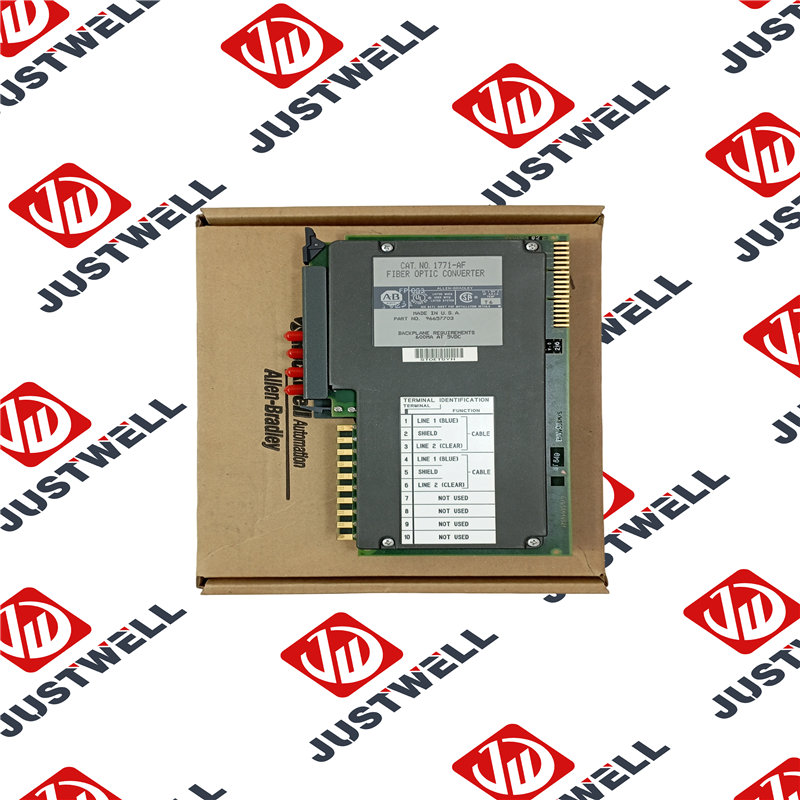
1771-AF A-B PLC-5 Fiber Optic Link Adapter
$ 95.67
- Free Delivery Over $30 All Products
- 30 days easy returns if you change your mind
- Order before noon for same day dispatch
Guaranteed Safe Checkout
- Description 1771-AF A-B PLC-5 Fiber Optic Link Adapter Product Dimensions: Product Description The Allen-Bradley 1771-AF is a Fiber Optic Converter Module designed for the PLC-5 control system family by Rockwell Automation. This module serves as a critical interface component that converts electrical signals from the PLC-5 Remote I/O network into optical signals for transmission over fiber optic cables. It enables the extension of Remote I/O networks over long distances while providing excellent immunity to electrical noise, ground loops, and electromagnetic interference (EMI). The 1771-AF is typically used in pairs (one at each end of the fiber link) to create a transparent bridge between two segments of a Remote I/O highway, allowing standard PLC-5 Remote I/O adapters (like the 1771-ASB) to communicate over fiber optics instead of coaxial cable. Technical Specifications Product Type: Fiber Optic Converter / Media Interface Module Compatible System: Allen-Bradley PLC-5 Family Network Protocol: Allen-Bradley Remote I/O (RIO) Input/Output Interface: Electrical Side: Standard BNC connector for coaxial cable (RG-6/U or equivalent), matching the standard PLC-5 Remote I/O physical layer. Optical Side: Fiber optic ports (typically ST or SMA connectors, depending on specific revision) for multimode fiber optic cables. Transmission Medium: Multimode Fiber Optic Cable. Transmission Distance: Extends Remote I/O network distance significantly beyond coaxial limits (typically up to several kilometers, dependent on fiber quality and specific module version, often cited around 2km to 4km for multimode). Data Rate: Matches the standard PLC-5 Remote I/O baud rate (57.6 kbps). Power Supply: Powered directly from the 1771 chassis backplane (requires installation in a 1771 series I/O chassis with appropriate power supply, e.g., 1771-P7). Operating Temperature: Typically 0°C to 60°C (32°F to 140°F). Storage Temperature: Typically -40°C to 85°C (-40°F to 185°F). Relative Humidity: 5% to 95% (non-condensing). Mounting: Installs directly into a standard 1771 series I/O chassis slot. Indicator LEDs: Status LEDs for Power, Transmit, Receive, and Fault conditions to aid in troubleshooting. Key Advantages Extended Distance: Overcomes the distance limitations of coaxial cable (approx. 300m per segment without repeaters), allowing Remote I/O networks to span several kilometers using fiber optics. Superior Noise Immunity: Fiber optic transmission is inherently immune to Electromagnetic Interference (EMI), Radio Frequency Interference (RFI), and electrical ground loops, making it ideal for electrically noisy industrial environments (e.g., near large motors, welders, VFDs). Electrical Isolation: Provides complete galvanic isolation between different segments of the plant floor, protecting sensitive control equipment from voltage surges and potential differences. Security: Fiber optic cables are difficult to tap without detection, offering enhanced security for critical control data. Lightweight and Compact: Fiber optic cables are lighter and often smaller in diameter than equivalent coaxial cables, simplifying cable tray management. Transparency: Operates transparently to the PLC-5 processor and Remote I/O adapters; no special configuration or programming is usually required beyond standard RIO setup. Reliability: Offers high reliability and reduced maintenance compared to copper-based solutions in harsh environments. Important Considerations & Precautions Pair Requirement: Fiber optic converters must be installed in pairs – one at each end of the fiber optic link – to convert electrical signals to optical and back again. Chassis & Power: The 1771-AF module requires installation in a powered 1771 series I/O chassis. It draws power from the chassis backplane; ensure the chassis power supply (e.g., 1771-P7) has sufficient capacity. Fiber Optic Cable: Requires suitable multimode fiber optic cable with compatible connectors (check specific module revision for ST vs. SMA). Cable quality and cleanliness of connectors are critical for reliable operation. Termination: The electrical (coaxial) side connected to the PLC-5 network still requires proper termination (typically 75-ohm terminators) at the ends of the overall RIO network segments, just like a standard coaxial setup. The fiber link itself does not require electrical termination. Compatibility: Ensure compatibility with other devices on the Remote I/O network (PLC-5 processors, 1771-ASB adapters, etc.) regarding baud rate and network loading. Legacy System: The PLC-5 system and 1771 I/O are considered legacy products by Rockwell Automation. While still supported for existing installations, new designs should consider newer platforms like ControlLogix or CompactLogix with modern networking options (EtherNet/IP, ControlNet). Replacement modules might only be available as refurbished or new old stock. Handling: Handle fiber optic connectors carefully. Keep protective caps on when not in use. Clean connectors properly before mating to prevent signal loss or damage. Avoid sharp bends in the fiber cable. Documentation: Always refer to the latest official Rockwell Automation user manual (e.g., publication number starting with 1771-UM) for detailed installation, configuration, and troubleshooting procedures specific to your hardware revision. Typical Applications Long-Distance I/O Connection: Connecting remote I/O racks located hundreds of meters or kilometers away from the main PLC-5 processor rack in large facilities like water treatment plants, oil refineries, mining operations, or sprawling manufacturing sites. Electrically Noisy Environments: Deploying control systems in areas with high levels of EMI/RFI, such as near arc furnaces, large variable frequency drives (VFDs), welding stations, or heavy machinery, where copper cables would suffer from data corruption. Ground Potential Differences: Linking I/O racks situated in different buildings or areas with significant ground potential differences, preventing ground loop currents that can damage equipment or corrupt data. Critical Process Control: Applications requiring high data integrity and reliability, where communication failures could lead to safety issues or significant production losses. Retrofitting/Upgrading: Extending the life and reach of existing PLC-5 systems without replacing the entire control architecture. Shipping Port: Xiamen, China Payment: Bank of Chicago, Bank of Singapore Express cooperation: fedex, DHL, UPS and your express account Service: Professional Sales provides 24 hours /7 days online service Please make an inquiry for more models: AB 1756-0B16E AB 1756-DMD30 AB 1756-IB32 AB 1756-0F4 AB 1756-DNB AB 1756-IB32/A AB 1756-0X8I AB 1756-DNB/A AB 1756-IF16 AB 1756-A10 AB 1756-DNB/A/B AB 1756-IF16/A AB 1756-A13 AB 1756-DNB/B AB 1756-IF161 AB 1756-A17 AB 1756-DNB/C1756-DNB/D AB 1756-IF16H AB 1756-A4 AB 1756-DNB/D AB 1756-IF4FXOF2F AB 1756-A7 AB 1756-DNB1 AB 1756-IF6CIS AB 1756-BA11 AB 1756-EN2T AB 1756-IF6I AB 1756-BA2 AB 1756-EN2T/C AB 1756-IF8 AB 1756-CFM AB 1756-EN2T/D AB 1756-IF8H AB 1756-CN2 AB 1756-EN2TR AB 1756-IF8U AB 1756-CN2/B AB 1756-EN2TR/B AB 1756-IG16 AB 1756-CN21 AB 1756-EN3TR AB 1756-IH16I AB 1756-CN2R AB 1756-ENBT AB 1756-IM16I AB 1756-CN2R/B AB 1756-ENBT/A AB 1756-IM16I1203-CN1 AB 1756-CNB AB 1756-ENET AB 1756-IN16 AB 1756-CNB/A/B/C/D AB 1756-EWEB AB 1756-IR6I AB 1756-CNB/D AB 1756-HSC AB 1756-IRT8I AB 1756-CNB/E AB 1756-HSC1 AB 1756-IT6I AB 1756-CNBR AB 1756-HYD02 AB 1756-IT6I2 AB 1756-CNBR/A/D AB 1756-IA16/A AB 1756-IV16 AB 1756-CNBR/D AB 1756-IA32 AB 1756-IV32 AB 1756-CNBR/E AB 1756-IB16 AB 1756-L1M1 AB 1756-CPR2 AB 1756-IB16/A AB 1756-L35E AB 1756-DHRIO AB 1756-IB16D AB 1756-L55M12 AB 1756-DHRIO/C AB 1756-IB16I AB 1756L55M13 AB 1756-DHRIO/D AB 1756-IB16ISOE AB 1756-L55M13 AB 1756-DHRIO/E AB 1756-IB16SOE AB 1756-L55M14 AB 1756L55M22 AB 1756-L55M16 AB 1756L55M16 AB 1756-L55M23 AB 1756L55M23 AB 1756-L55M22